
Neighbourhoods
Farringdon restaurants — the best restaurants in Farringdon and Clerkenwell's converted rooms
Farringdon and Clerkenwell trade on converted industrial buildings — a former courthouse, old print works, warehouse conversions — and the Farringdon restaurants inside them tend to match the ambition of the architecture.
What Farringdon is for
A destination lunch worth booking weeks ahead, in a building with real history behind it — the Farringdon restaurants here are a handful of rooms doing one thing very well, rather than a strip to wander.
Worth a wander
Clerkenwell Green and the surrounding lanes, quieter than Smithfield but just as close to the City — one of the few genuinely old street layouts left in this part of London, since the area escaped the worst of the postwar rebuilding that reshaped much of the City fringe.
A working history worth knowing
Clerkenwell’s industrial past runs deeper than the current wave of restaurant conversions suggests — this was London’s centre for watchmaking and precision engineering through the 19th century, and later a printing and publishing district, which is why so many of the area’s best rooms still sit inside genuine former workshops and print works rather than purpose-built restaurant space.
Exmouth Market, a pedestrianised strip a few minutes from Farringdon station, has been a food destination since well before “Farringdon dining” became a phrase — Moro anchored the street from 1997 onward, and the market itself still runs a stall-based food offer alongside the sit-down restaurants.
Getting here
Farringdon station is genuinely well-connected — the Elizabeth line, Thameslink, and the Circle/Hammersmith & City/Metropolitan lines all stop here, making it one of the easier parts of central London to reach directly rather than via a connection. It’s a five-to-ten-minute walk to most of the neighbourhood’s restaurants from the station, and close enough to Smithfield and the City fringe that all three areas are walkable in a single evening if the plan calls for it.
How it compares to Smithfield next door
Farringdon and Smithfield blur into each other geographically, but the dining register differs slightly: Smithfield still runs on the meat market’s early-hours rhythm (serious breakfasts, nose-to-tail cooking), while Farringdon and Clerkenwell proper lean more toward destination dinners in converted industrial buildings, with Exmouth Market adding a more casual, market-stall layer on top.
What it costs
Farringdon and Clerkenwell’s destination restaurants — the kind built into a converted courthouse or print works — sit at a genuine special-occasion price point, reflecting both the ambition of the cooking and the cost of the buildings themselves. Exmouth Market’s more casual stalls and smaller kitchens bring the average down considerably if a big-night-out budget isn’t the plan.
The courthouse story
Sessions Arts Club’s building is a genuinely rare survival — the old Middlesex Sessions House, a working courthouse until the mid-20th century, later spent decades derelict before its recent restoration into a restaurant that kept much of the original courtroom architecture intact rather than stripping it out.
It’s one of the clearest examples anywhere in London of a building’s previous life staying visible in its current one, and worth knowing the history before a visit rather than discovering it by accident once inside.
When to visit
Smithfield’s early-morning rhythm bleeds slightly into Farringdon’s own breakfast scene, but the neighbourhood proper comes into its own from lunchtime onward — Exmouth Market in particular is at its best on a weekday lunch or a weekend afternoon, when the stalls and the surrounding restaurants are both running at full tilt.
Frequently asked questions
Is Farringdon the same as Clerkenwell?
Not exactly, but the names overlap in everyday use — Farringdon is technically the station and the immediate area around it, while Clerkenwell is the wider historic district surrounding it. Most people, including most restaurants’ own addresses, use the two names fairly interchangeably.
How do I get to Farringdon?
Farringdon station is served directly by the Elizabeth line, Thameslink, Circle, Hammersmith & City, and Metropolitan lines — one of the best-connected stations in central London, and usually the easiest single interchange for a cross-London journey.
Is Farringdon good for a date-night dinner, or more of a lunch spot?
Genuinely both — Smithfield’s kitchens lean toward early, hearty lunches tied to the market’s own hours, while Clerkenwell and Exmouth Market’s restaurants are just as strong for an evening booking, several of them destination-worthy enough to plan an evening entirely around.
Is Exmouth Market worth a visit outside of a specific restaurant booking?
Yes — it’s a genuinely pleasant pedestrianised street to wander even without a specific destination, with a mix of sit-down restaurants, casual food stalls, and independent shops that rewards an unplanned half-hour as much as a booked table.
Where to eat
5 restaurants-

Moro
The restaurant that pioneered Andalusian and North African cooking in London, anchoring the whole Exmouth Market strip since 1997.
Spanish / North African -

Sessions Arts Club
The top floor of the former Clerkenwell courthouse, up a staircase you would not find unless you knew.
Modern British / Italian -

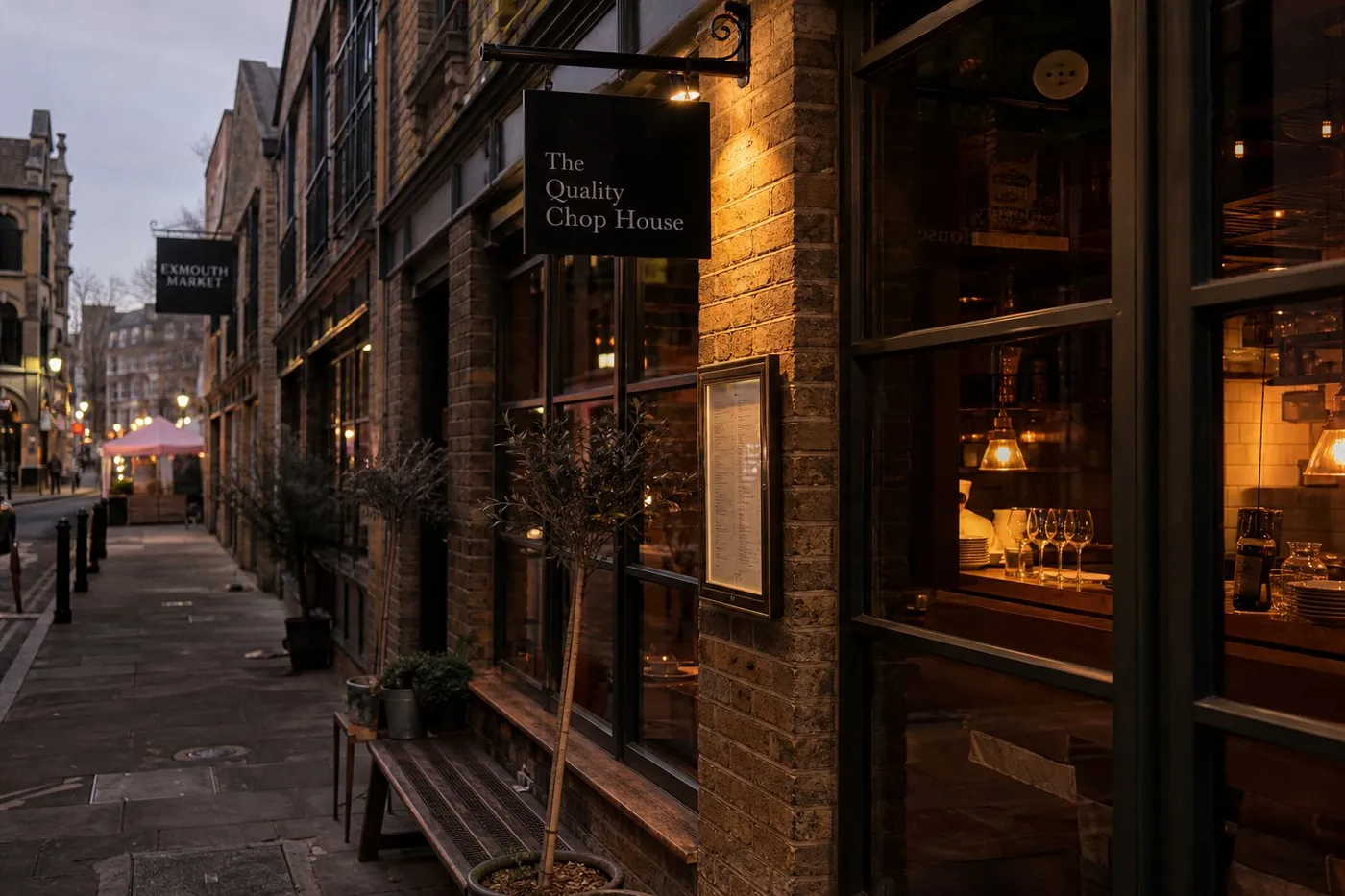
The Quality Chop House
A Grade II-listed Victorian working-men's dining room from 1869, original wooden benches included.
British (chops, steaks) -

Morito
Moro's noisier, narrower sibling two doors down — the same Moorish pantry compressed into tapas, eaten fast at a counter.
Spanish / North African tapas -

Luca
The Clove Club team's Italian-via-British-produce room on St John Street — one Michelin star, and pasta that justifies the reputation.
Modern Italian