
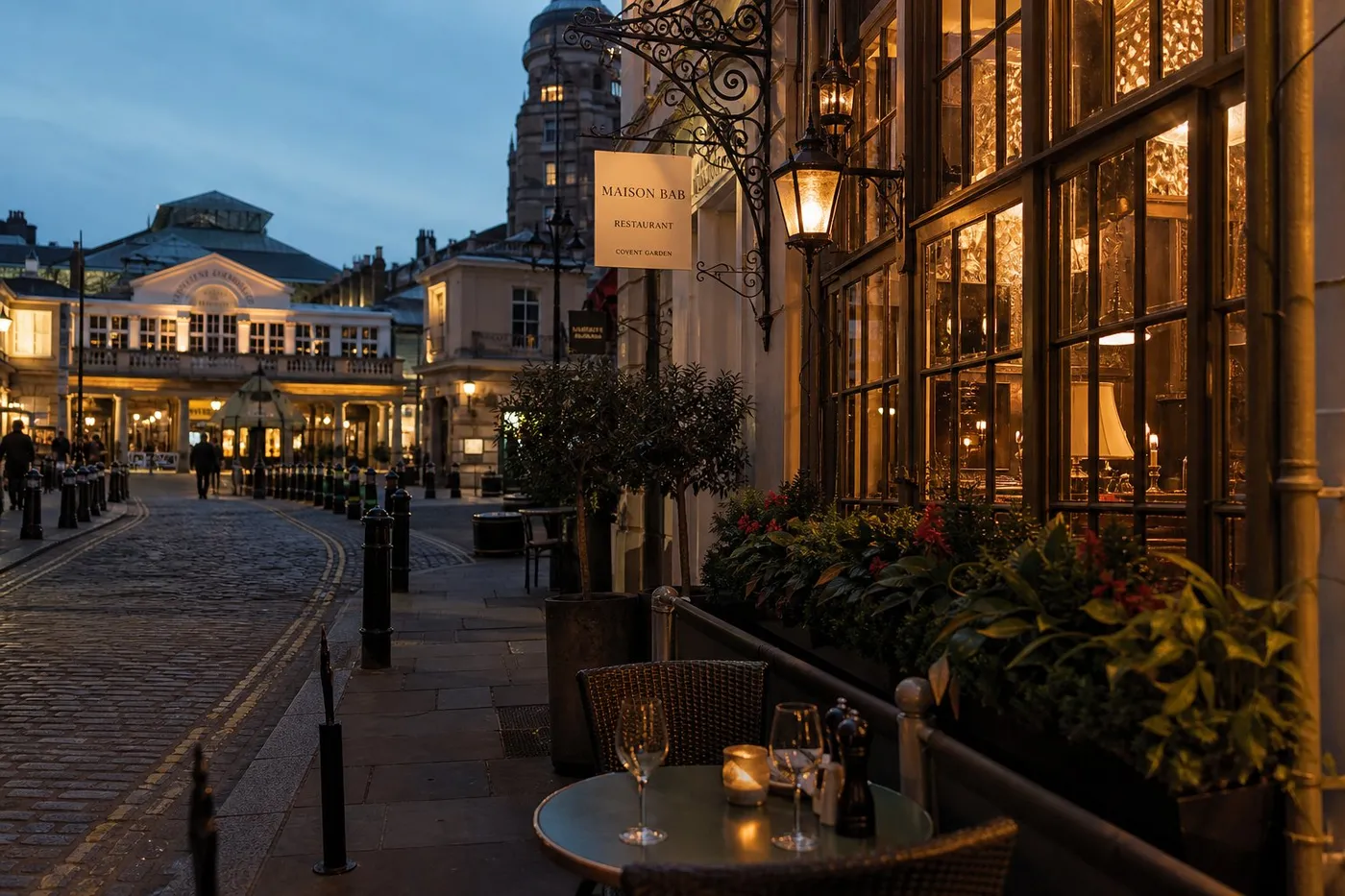
Neighbourhoods
Covent Garden restaurants — the best pre-theatre and post-curtain dining in Covent Garden
Covent Garden runs on theatre timings more than any other part of London — pre-show sittings, post-curtain suppers, and a market crowd that never really thins out during the day. The Covent Garden restaurants worth booking are the ones that plan around a curtain call.
What Covent Garden is for
Pre- and post-theatre dinners timed around a curtain call. Book a table for the two hours before an evening show, or later than 10pm afterward, and skip the crowded middle window most visitors default to — the Covent Garden restaurants that know their audience are already running two sittings.
The market and the piazza
The old market building at the heart of Covent Garden — a working fruit-and-vegetable market until 1974, now a covered arcade of shops and cafés — is still the neighbourhood’s visual anchor, with street performers working the piazza outside it most afternoons and evenings.
Seven Dials, a few minutes’ walk north-west, has quietly become the more interesting half of the neighbourhood for actual dining and drinking: a genuine cluster of independent restaurants and bars radiating out from the seven-street junction, distinct from the market’s more tourist-facing chains.
Timing around the theatres
London’s major theatres — the Royal Opera House, the Lyceum, the Novello, and a dozen others — sit within a few minutes of each other here, and the whole neighbourhood’s dining rhythm bends around their curtain times.
A 6pm or 6:30pm sitting is the standard pre-theatre booking, tight enough that many restaurants run a dedicated set pre-theatre menu built for speed; the alternative is a late dinner after 10:30pm once the evening crowds have thinned and kitchens can relax back into a normal pace.
Getting here
Covent Garden station (Piccadilly line) sits right in the middle of the neighbourhood, though Leicester Square and Holborn are both a similarly short walk and often less congested, particularly around a show’s start or end time when Covent Garden station itself can be genuinely crowded.
What it costs
Expect a genuine premium here relative to less central neighbourhoods — the market building’s own restaurants price in the footfall and the theatre-crowd captive audience, and a pre-theatre set menu, while good value for what it includes, is rarely the cheapest way to eat in London. Seven Dials’ independent restaurants generally offer a fairer price for the quality than the piazza itself.
When to visit
Matinee days bring a distinct lunchtime and mid-afternoon rhythm on top of the usual evening curtain times, so it’s worth checking a specific theatre’s schedule before assuming the neighbourhood’s quiet hours will hold. The piazza itself is at its liveliest through the afternoon, when street performers and the market crowd overlap most.
Beyond the theatres
It’s worth remembering that Covent Garden existed as a food destination long before it became synonymous with pre-theatre dining — the fruit-and-vegetable market operated on this site from the 17th century until 1974, when it relocated south of the river and the old market building was saved from demolition and converted into the shopping arcade it is today.
That near-demolition is a useful piece of context: much of what makes Covent Garden distinctive now (the covered market hall, the piazza’s open space) survived by a genuinely narrow margin, at a moment when large parts of historic London were being cleared for redevelopment.
Frequently asked questions
How early should I book a pre-theatre dinner in Covent Garden?
For a popular restaurant on a Friday or Saturday, book at least a week ahead. Weeknight pre-theatre slots are considerably easier to secure with a few days’ notice, since the crowds are lighter and turnover faster.
Is Seven Dials part of Covent Garden?
Informally, yes — Seven Dials sits at the western edge of what most Londoners consider Covent Garden, close enough to walk between the two in a few minutes, though it has its own distinct, less market-driven character.
Is Covent Garden too touristy for a good meal?
The market building itself skews tourist-facing, but the surrounding streets — particularly toward Seven Dials — hold genuinely good, less obviously touristy restaurants. It’s worth walking a few minutes off the piazza itself before settling on somewhere.
What's the best way to get a late dinner after a show?
Book ahead if a specific restaurant matters — post-theatre demand is real and predictable, so kitchens plan for it — but several rooms around Seven Dials keep later kitchen hours specifically to catch that crowd, and same-day availability is more realistic there than at the market’s more famous names.
Where to eat
6 restaurants-

Clos Maggiore
The 'forever spring' conservatory — blossom, candlelight, a retractable glass roof — routinely called London's most romantic dining room.
Modern European / French -

J Sheekey
A 100-year-old seafood institution tucked behind the Coliseum, with a pre-theatre menu built for the job.
Seafood -

Rules
London's oldest restaurant, established 1798, still doing game pie and its own-estate grouse.
Traditional British -

Barrafina, Drury Lane
The Drury Lane counter — no bookings, an open kitchen, and a queue that's part of the point.
Modern Spanish tapas -

Balthazar
A big, tiled, buzzy Keith McNally-style brasserie built to fit around a curtain time.
French brasserie -

Cato
Angelos Bafas's five-storey Seven Dials opening: an upstairs julep bar with home-grown mint, a seven-colour cocktail menu below.
Cocktail bar