
The File
The Best Italian Restaurants in London
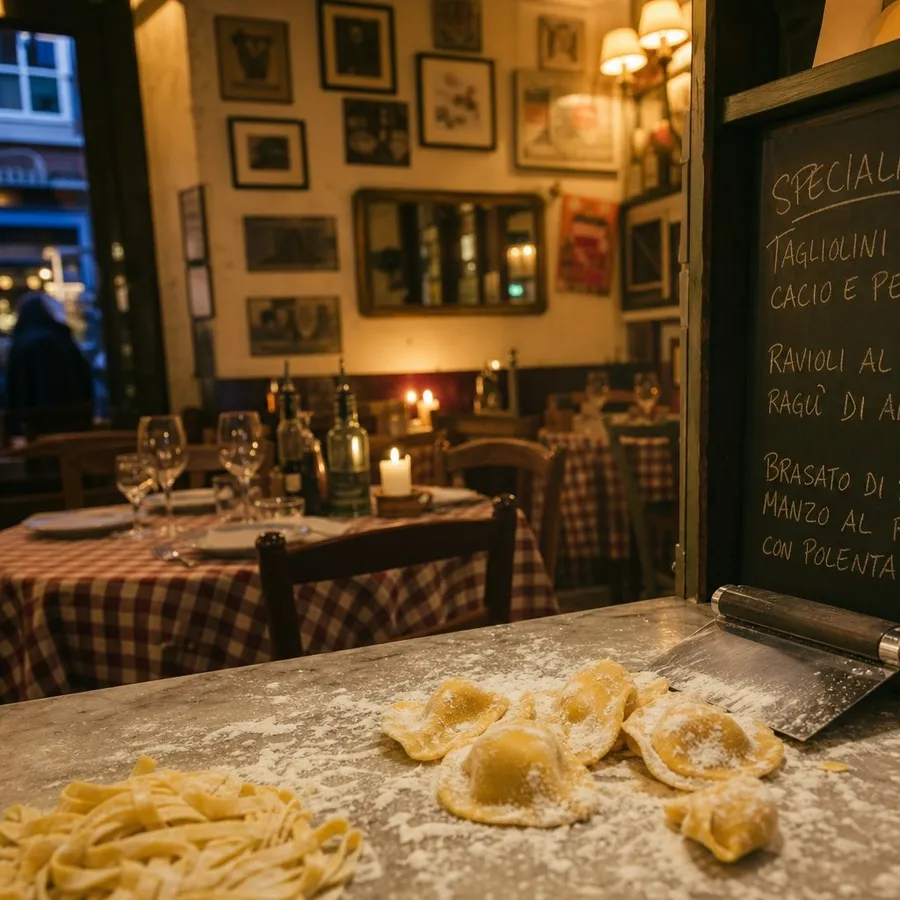
London’s Italian restaurants split roughly into two camps: rooms that have been doing one region’s food properly for decades, and a newer wave built around a single, obsessively narrow idea — one pasta shape, one Roman-style pizza, one deli counter turned into a dining room. Both camps are represented here.
What isn’t represented is the version of “Italian” that means a laminated menu with twelve pasta dishes and none of them memorable; every restaurant below earns its place on a specific strength, not a broad, safe average. The city’s relationship with Italian food is older than most visitors assume.
Soho’s Old Compton Street area was London’s original “Little Italy” from the late nineteenth century onward, and the post-war generation of family-run rooms — Franco’s among them — grew directly out of that community rather than out of any restaurant-group strategy.
What’s changed more recently is the shape of the newer openings: instead of a single restaurant trying to cover the whole of Italian cooking, the last decade or so has produced a wave of places that pick one format — a pasta counter, a pizza style, a salumeria — and build the entire business around doing that one thing better than anyone else in the city.
Both eras are represented below, and the newer format doesn’t make the older one obsolete; they’re solving different problems for a diner.
Old-school rooms that have earned their reputation
Franco’s, on Jermyn Street, has been open since 1946 and still runs like a proper St James’s institution — the kind of dining room where regulars are greeted by name and the wine list has the depth to match the room’s age. Under chef Stefano Turconi, the cooking stays closer to classic Italian technique than to trend, which is exactly the point at a restaurant this established: eighty years of continuous service in the same part of London is not something a menu built around whatever’s currently fashionable could sustain. Read the full review.
Ciao Bella, on Lamb’s Conduit Street in Bloomsbury, is the opposite kind of old-school: no pretension, a huge menu, and a room that’s been feeding the same Bloomsbury crowd for years without needing to reinvent itself. It’s the trattoria a neighbourhood actually uses on a Tuesday, not the one built for a review — and that distinction is worth more in practice than another tasting menu would be. Read the full review.
The River Cafe, on the Thames at Hammersmith, sits in a different category entirely — Ruth Rogers’ restaurant essentially wrote the modern British template for treating Italian ingredients with total seriousness and minimal intervention, and three decades on it’s still the reference point every “ingredient-led Italian” restaurant since has been measured against. The kitchen has changed hands over the years without the underlying philosophy shifting: source the best available ingredient, then do as little to it as the dish allows. It is not a cheap booking, and it was never trying to be one. Read the full review.
The narrow-focus specialists
Trullo, in Highbury, is built entirely around Tim Siadatan’s pasta and a wood-fired grill, and the discipline shows — this is a kitchen that decided early on what it does well and has spent years refining that rather than expanding the menu to cover more ground. The upstairs dining room is where the reputation was built; the ground-floor bar downstairs is the better option for a shorter, walk-in visit if the main room is fully booked. Read the full review.
Flour & Grape, on Bermondsey Street, runs the same logic in miniature: a small handmade-pasta menu, rotated seasonally, with nothing on it that isn’t pasta or a pasta-adjacent starter. It’s one of the more honest examples in London of a kitchen that has picked its lane and stayed in it rather than adding a grill section or a longer wine list just because a bigger menu is easier to market. Read the full review.
Padella, on Southwark Street at the edge of Borough Market, is the pasta counter that made the no-reservations queue a genuine London dining ritual rather than an inconvenience — the food comes out fast, the prices stay low for the quality, and the format (long shared tables, a short blackboard menu, pasta hand-rolled in the window) has barely changed since it opened in 2016. Arrive early or expect to wait; it doesn’t take bookings, and the queue is now as much a part of the experience as the pici cacio e pepe.
Conchiglia, on Great Titchfield Street in Fitzrovia, narrows further still, into Roman-style pizza specifically — thin, crisp-based, cut into strips rather than wedges in the traditional Roman manner, and a genuinely different eating experience from the Neapolitan pizza that dominates most of London’s “best pizza” conversation. It’s a useful corrective for anyone who thinks “London pizza” means one style. Read the full review.
Bar Lina, tucked beneath Lina Stores’ Brewer Street deli in Soho, works the aperitivo end of the specialist approach — a tightly focused Negroni-and-small-plates list built for a shorter, less formal evening than a full three-course dinner would suit. Read the full review.
Bocca di Lupo, tucked away on Archer Street in Soho since 2008, takes the opposite approach to narrowness: chef-owner Jacob Kennedy built the menu around regional Italian cooking specifically, rotating dishes from different parts of Italy rather than settling into one region’s repertoire, and the Michelin Guide’s Bib Gourmand recognition reflects a kitchen that has kept that ambition consistent for close to two decades. Portions are deliberately sized for sharing across several small plates rather than one main course each, so it rewards a table willing to order broadly rather than cautiously.
Manteca, on Curtain Road in Shoreditch, pushes the specialist idea toward nose-to-tail butchery: co-owners Chris Leach and David Carter run an in-house salumeria alongside a hand-rolled pasta programme, curing their own prosciutto and other cured meats on site rather than buying them in. It’s a genuinely different proposition from most of the names above — less a trattoria than a butcher’s counter that also happens to make excellent pasta — and it fits Shoreditch’s more experimental, less formal dining scene better than a traditional dining room would.
The deli-to-dining-room wave
Lina Stores started as a Soho deli on Brewer Street in 1944, selling imported Italian produce to a neighbourhood that didn’t have easy access to it — and the restaurant arm, now running from its own room on Greek Street as well as the original deli site, has kept that provenance-first instinct at the centre of the menu rather than treating it as marketing. Eighty years of trading as a deli first gives the pasta counter a credibility that a restaurant built around pasta from day one would have to earn from scratch; here, the ingredients were the whole business before the dining room existed. It’s a useful reminder that some of London’s best “new” Italian openings are really old businesses finding a second act.
What separates a good one from an average one
The restaurants above earn their place for different reasons, but a few things recur across all of them. None is trying to cover every region of Italy at once — even Bocca di Lupo’s rotating regional menu is still working from a single, coherent idea rather than a “something for everyone” strategy.
Most either make their pasta in-house and visibly (Padella’s window, Manteca’s pasta programme, Flour & Grape’s short seasonal list) or have built decades of trading history that a newer opening simply can’t fake (Franco’s, Ciao Bella, The River Cafe). And the ones that specialise — Roman pizza at Conchiglia, nose-to-tail Italian butchery at Manteca — tend to do that one thing more convincingly than a broader menu covering the same ground would.
Price is the other genuine variable worth planning around, and it doesn’t map neatly onto formality. A counter seat at Padella or a pasta plate at Flour & Grape is one of the more affordable proper dinners in central London; a table at The River Cafe is a different kind of booking entirely, priced for what it is rather than for what a quick weeknight dinner should cost.
Matching the restaurant to the occasion matters more here than defaulting to whichever name is best known.
How to choose
For a special-occasion booking with real history behind the room, Franco’s or The River Cafe. For a fast, honest weeknight plate of pasta without a reservation, Padella or Flour & Grape. For pizza that doesn’t taste like every other pizza in the city, Conchiglia. For a shorter, aperitivo-led evening rather than a full dinner, Bar Lina.
For something closer to a butcher’s counter than a trattoria, Manteca. None of these need a special occasion as an excuse — that’s largely the point of a good Italian restaurant.
Frequently asked questions
Do I need to book ahead at these Italian restaurants?
It depends which register you’re after. Padella and Flour & Grape run no-bookings queues by design — turn up and expect a wait rather than trying to plan around a table. Franco’s, The River Cafe, and Bar Lina all take reservations and are worth booking ahead for a weekend, especially The River Cafe for a well-known evening slot.
What's the difference between a trattoria and a proper Italian restaurant?
Nothing formal — “trattoria” is a register rather than a legal category, generally implying a simpler, more affordable, family-style room than a “ristorante.” Several names on this list, like Padella and Flour & Grape, lean trattoria in spirit (counter seating, a short focused menu) without using the word themselves.
Is regional Italian cooking (like Sicilian at Norma or Conchiglia's pizza) actually different from "generic" Italian food?
Yes, meaningfully. Italy’s regional cuisines vary as much as, say, French and Spanish cooking do — a Sicilian menu built around citrus, capers, and North African-influenced spicing has little in common with a Roman trattoria’s cacio e pepe, beyond both technically being “Italian.” The restaurants on this list that commit to a specific region generally reward that specificity with a more distinctive plate than a broad pan-Italian menu manages.
Which of these is best for a group booking?
Franco’s and The River Cafe both handle larger tables comfortably and are used to booking groups in advance. The no-bookings rooms (Padella, Flour & Grape) are a harder sell for a group of six or more, since a queue that’s manageable for two people becomes a genuine wait for a larger party.
Are any of these good for a solo weeknight dinner?
Padella and Flour & Grape’s counter seating suits a solo diner particularly well — both are built around fast, honest pasta rather than a leisurely multi-course occasion, and neither expects a party of one to justify itself the way a formal dining room might.